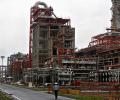
The Rs 3-trillion West Coast or Nanar refinery has all the potential to become India's flagship petrochemicals project, with the planet's largest oil producer Saudi Aramco as its biggest shareholder. Yet the locals don't see the plant as a harbinger of better times.

Credit card payments to buy fuel at petrol pumps will from October 1 not get a 0.75 per cent discount that State-owned oil companies had introduced more than two-and-a-half years back to promote digital payments.

Markets crashed due to domestic worries; bluechip stocks tanked too.

IOC, BPCL and HPCL on Thursday afternoon stopped ATF supplies to Air India at six airports - Kochi, Pune, Patna, Ranchi, Vizag and Mohali - over payment defaults. AI flights from these places were tanking up from other airports.

Oil imports are a third of India's total import bill.
D-Street is hoping RBI policy review meeting on Tuesday will uphold its stand on easing of interest rates
Older workers are headed for the VRS exit in larger-than-expected numbers even as unrest stirs over unrevised wage settlements.

Digital-pay companies see 10x growth spurt after demonetisation, report Ayan Pramanik & Shine Jacob/Business Standard from Bengaluru.

The 30-share Sensex ended down 538 points at 26,781 and 50-share Nifty ended down 152 points at 8,067.

Inclusive of the July hike of 25 paise, a monthly increase of similar amount would result in a saving of Rs 2.25 a litre for the current financial year alone.
Reason behind for the change in his stance: gas price increase.

These firms offer job security and lucrative salries.

Oil prices have declined by more than 60 per cent since January with benchmark crude falling well below $30 per barrel, driven by an acute oil demand decline caused by the coronavirus and a lack of production cuts by OPEC and other oil producing countries.

ONGC is raising debt for a spate of acquisitions over the past year
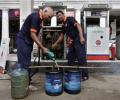
The latest round of petrol and diesel price increase, on Thursday, met with opposition from many corners.

Vedanta group chairman, Anil Agarwal, 69, is well known for his business journey from a scrap dealer from Bihar to a London-based globe-girdling metal and oil and gas conglomerate with revenues of $19 billion. Now his abilities to keep his group from over-leveraging itself will be put to the test. Over the years, Agarwal, now based in London, set up the conglomerate via acquiring iron ore producer Sesa Goa, Cairn's oil producing assets in India, and Electrosteel Steel.
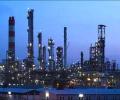
These refineries, commissioned mostly in the 1950s and 1960s during India's early industrialisation push, are inefficient and costly to maintain compared to their modern counterparts on the coast mainly operated by private companies.

Most analysts expect growth in the sales of Nifty-50 companies to decelerate, albeit marginally, in the quarter ended December compared to the corresponding period of 2013-14, with metals and real estate companies pulling down earnings.

This will encompass the sale of Air India, a number of other privatisation initiatives, mergers, initial public offerings, the Centre's two exchange-traded funds, buybacks and offers-for-sale, and even monetisation of land assets.

Markets ended in green on rate cut hope.

'We aren't so unreasonable as to demand that he should have fully reversed Indira Gandhi's worst economic legacy, bank nationalisation.' 'But he could have made a beginning by selling off the two most stressed small public sector banks, and then announced that each year for the next 10, one government bank with the most messed-up balance sheet will be sold.' 'It would have electrified the markets, shocked his other banks into better behaviour, and marked his name among the great reformers,' argues Shekhar Gupta.

Diesel makes up nearly half of fuel demand in Asia's No 3 economy.

Analysts are enthused by BPCL's upstream foray and have re-rated the stock in the past couple of years.

It may be the season for corporate matchmaking but India Inc's record of managing partnerships is far from impressive, says Shailesh Dobhal.

Low fuel prices to help oil marketing and refining sectors but upstream players will stay under pressure.

'I have no problems with the finance ministry or with state governments treating petrol pump prices as the last resort for meeting their ambitious spending targets with very limited revenue resources.' 'But let's do away with this smokescreen of free pricing of petrol and diesel and go back to administered pricing regime,' says Dr Sudhir Bisht.

India may see a structural shift in supplies of crude oil with Russia emerging as a key source of fuels, a development that reduces New Delhi's dependence on West Asian oil, gives Indian refiners better bargaining power with price-setter Saudi Arabia, and improves overall energy security. The unexpected surge in supplies of Russian crude in the last few months, unthinkable until the war in Ukraine, may also deliver other unforeseen gains such as boosting exports of refined fuels to Europe, which historically has counted on Russian shipments. India has jumped on to the bandwagon of opportunistic buying of Russian crude but if calibrated carefully, Urals crude can be a long-term asset for India refiners.

The government has tweaked the income tax laws to make it easier for the new owners of loss-making public sector undertakings (PSUs) to carry forward the accumulated losses and set them off against future profits. This will result in significant tax savings for the new owners if they are able to turnaround operations of the ailing PSU within a few years. This will, in turn, boost the post-tax earnings and returns for the new owners.

'The correction could take two to three months and traders need to be careful.' 'For investors, this could be a good time to nibble in.'

Sun Pharma was by far the biggest gainer in the Sensex pack, surging 8.13 per cent, followed by Dr Reddy's at 4.92 per cent.

'If Indians are as smart as their counterparts in university, and have equal opportunity, then what is the reason that we cannot produce inventions of quality that are recognised by the world?'
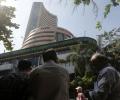
Brokers said a flurry of buying by investors in blue-chips mainly influenced the sentiment.
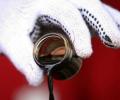
The government shouldn't hide behind the veil of making a domestic giant out of the HPC-ONGC deal, rather it should just say it needs cash from this divestment exercise, says Sudhir Bisht.

The fall in international oil prices had resulted in six consecutive reduction in petrol prices since August and two in diesel in the last one month and there was possibility of another round of cuts this weekend.
The National Democratic Alliance government is weeding out independent directors on the boards of public-sector undertakings (PSUs).
Though the NDA government had been trying to privatise 20 companies, a decision for which was taken in 2017, and included national carrier Air India, the investor community evinced little enthusiasm for any of them. Now, with an in-principle approval for privatisation of BPCL, CCI and SCI, the government has taken the plunge again.

Oil firms' borrowings could fall by up to Rs 15,000 cr, govt's subsidy bill by 12% .

Stocks of public sector undertakings (PSUs) have been on fire in the past year as investors cheered an improvement in key operating metrics and embraced counters of these state-owned enterprises, analysts suggest. The S&P BSE PSU Index has gained over 90 per cent in the past year, rising much higher than the S&P BSE Sensex, which has rose nearly 19 per cent during this period, according to ACE Equity data. The BSE PSU Index, reports show, has delivered a compound annual growth rate (CAGR) of 28 per cent (including dividends reinvestments) over five years and risen by almost 60 per cent in the past year.
Markets extended losses to end 1.5% down on Tuesday, amid weak global cues, after investors turned cautious ahead of key economic data and booked profits in rate sensitive shares while the further fall in the rupee continued to weigh on investor sent.
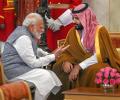
'We began foolishly bragging about Saudi-Emirati investment plans as indicative of the sheikhs 'distancing' from Pakistan, including on Kashmir,' notes Ambassador M K Bhadrakumar.
